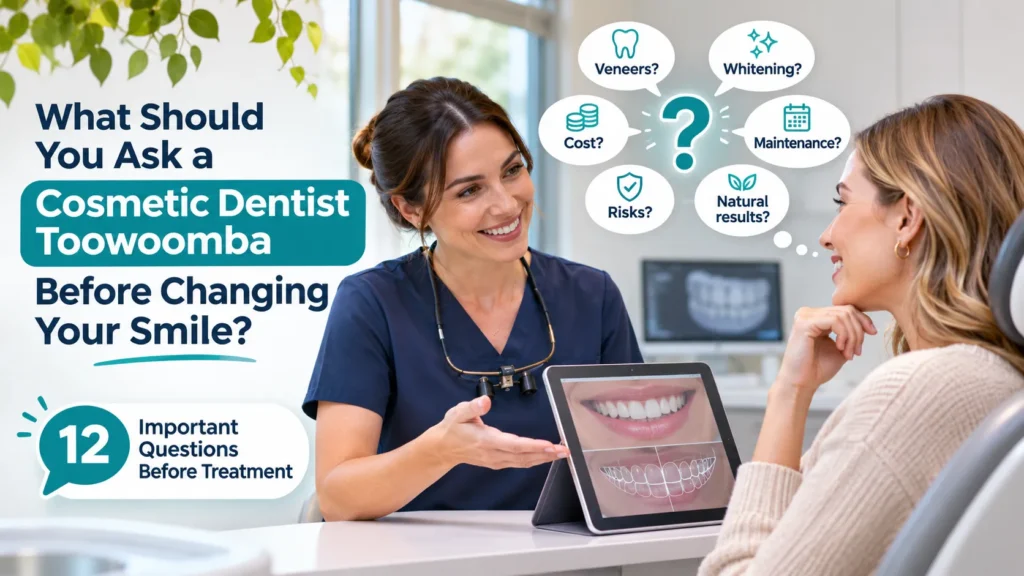
There’s a particular moment that happens when someone starts thinking seriously about cosmetic dental treatment.
It might begin with a photograph, a wedding invitation or a front tooth that has bothered them for years.
They search online. They see beautiful smiles. They compare treatments, scroll through videos and save a few before-and-after photographs.
Then they book a consultation.
But when they sit down in the dental chair, they suddenly realise something: they’re not entirely sure what to ask.
Should they mention the price first? Ask about veneers? Bring photographs? Explain that they want something subtle rather than dramatic?
If you’re looking for a cosmetic dentist Toowoomba, the quality of your consultation matters just as much as the treatment you eventually choose.
A cosmetic consultation isn’t simply an opportunity to select a procedure. It’s your chance to understand your existing teeth, what can realistically be changed, which alternatives are available and what your decision may mean years from now.
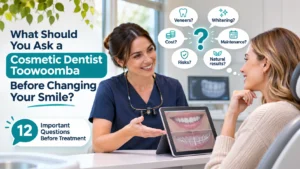
Here are 12 questions worth asking before making changes to your smile.
Quick Answer: What Makes a Good Cosmetic Dental Consultation?

A useful cosmetic dental consultation should address your concerns, oral health, treatment options, likely benefits, potential risks, alternatives, costs and long-term maintenance.
It should also give you an opportunity to ask questions without feeling pressured to make an immediate decision.
An experienced, appropriately qualified and registered dental practitioner should be able to explain why a treatment is or isn’t suitable for your circumstances.
Remember, cosmetic dentistry isn’t a separately recognised dental specialty in Australia. Rather than relying on labels such as “cosmetic specialist”, consider a practitioner’s registration, relevant experience, communication and the suitability of their proposed treatment plan.
Question 1: Is My Main Concern Actually Cosmetic?
This might seem like an unusual first question.
After all, you’ve booked an appointment because you want your teeth to look different.
But appearance concerns sometimes have underlying clinical causes.
For example, a darkening tooth could have experienced trauma. Uneven tooth edges could reflect grinding. Changes in tooth position might be associated with gum problems or other dental conditions.
A dentist needs to distinguish between healthy anatomical variation, cosmetic concerns and problems that require clinical attention.
Imagine noticing that your two front teeth have become shorter over the past few years.
You might assume veneers are the answer.
But if grinding is causing ongoing wear, simply placing restorations without considering the bite could leave those restorations at risk.
A good consultation begins with an appropriate examination.
If disease or damage is identified, those issues may need attention before elective cosmetic treatment.
At Westbrook Family Dental, patients can learn more about foundational dental assessment through our general dentistry services.
Question 2: Can I Explain What I Want Without Knowing the Treatment Name?
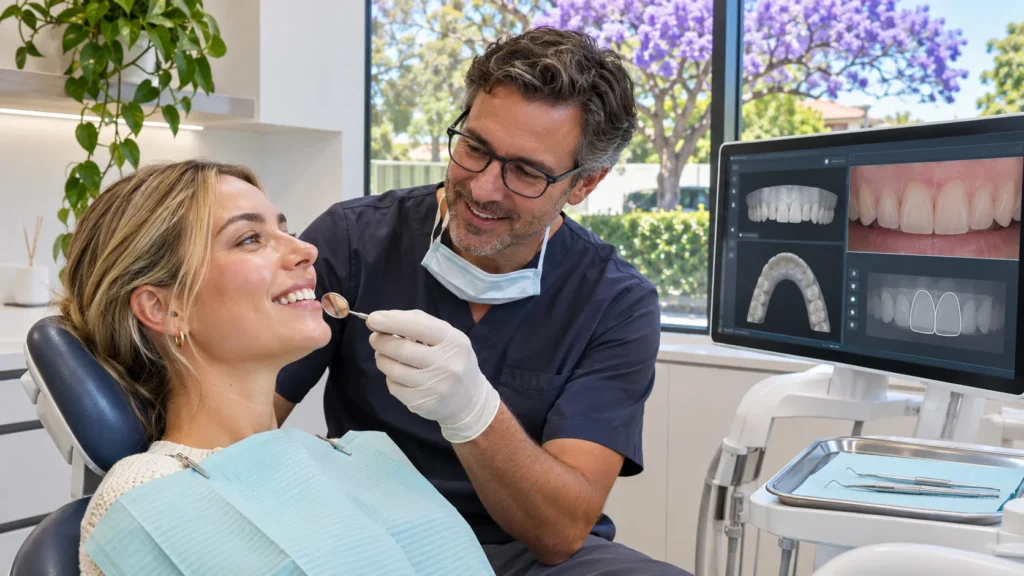
Absolutely.
You don’t need to walk into a dental clinic knowing whether you need bonding, veneers or whitening.
In fact, it may be more helpful to describe the particular issue that concerns you.
Consider the difference between these two statements:
“I want six veneers.”
And:
“I notice my front teeth are uneven in photographs, but I don’t want to change their natural appearance too much.”
The second statement tells the dentist considerably more about your goals.
It leaves room for an assessment of whether any treatment is necessary and which options might address the concern.
Useful descriptions include:
- “One tooth looks darker than the others.”
- “I dislike the small chip on my front tooth.”
- “I want a subtle colour improvement.”
- “My teeth seem shorter than they used to.”
- “I would prefer to preserve as much natural enamel as possible.”
- “I’m worried about ongoing maintenance.”
- “I want to understand the costs before deciding.”
You can bring photographs as a way of explaining your preferences, but remember that another person’s teeth may not be a realistic or desirable template for your own smile.
Question 3: What Are My Treatment Options, Including Doing Nothing?
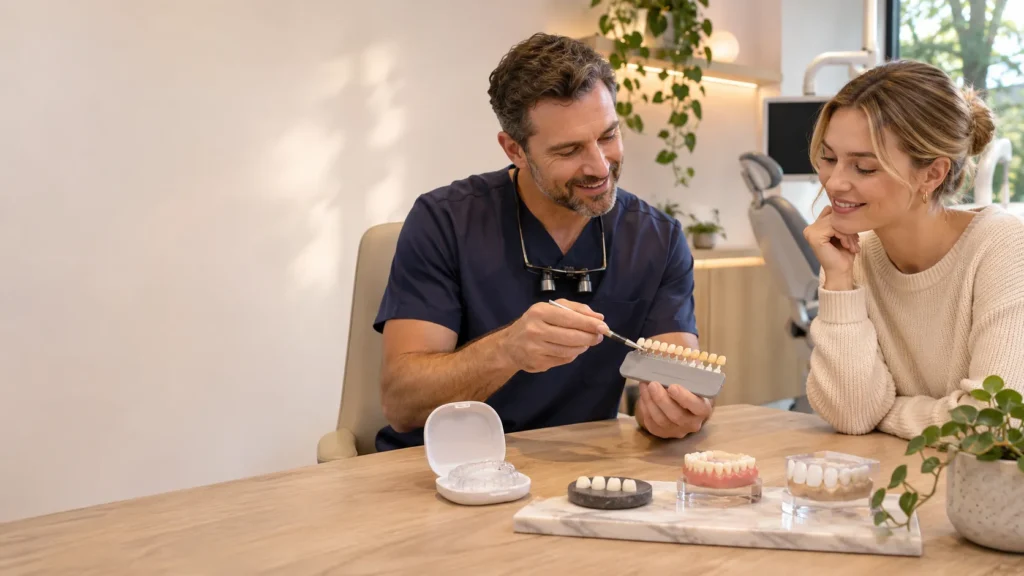
This is one of the most important questions in the entire consultation.
There is rarely a single treatment that suits every cosmetic concern.
If you have a chipped tooth, for instance, options may include monitoring, smoothing an edge, bonding or another restoration depending on the clinical findings.
If your concern is tooth colour, cleaning or whitening might be considered.
If a tooth is misaligned, orthodontic assessment may be more appropriate than changing its visible shape with a restoration.
Sometimes the best course of action is simply to leave a healthy tooth alone.
A good explanation should include why a treatment is being recommended, what alternatives exist and what could happen if you choose not to proceed.
For patients researching cosmetic dentistry Toowoomba, this is an important distinction: a consultation should help you make a decision, not merely sell you a procedure.
Question 4: How Much of My Natural Tooth Will Be Changed?
Not all cosmetic treatments involve the same degree of intervention.
Professional cleaning is different from whitening. Whitening is different from bonding. Bonding is different from preparing a tooth for a veneer.
Some approaches may be minimally invasive or non-invasive, while others can require irreversible removal of tooth structure.
For instance, certain veneers require removing enamel to allow room for a restoration.
Once enamel has been removed, the tooth may continue to require restorative care in the future.
Ask the dentist to explain exactly what will happen.
Does the planned treatment involve drilling?
Would the tooth need to be reshaped?
Is the procedure reversible?
Would the restoration eventually need replacing?
What might happen if you decide not to maintain it?
These questions are especially important if your teeth are currently healthy and functional.
There is no need to rush into irreversible treatment simply because an alternative promises a dramatic appearance change.
Question 5: What Would a Natural-Looking Result Mean for My Smile?

The words “natural smile” can mean different things to different people.
One person imagines brighter teeth with gentle colour variation.
Another wants more even edges but prefers to keep the original shape of their teeth.
Someone else wants to address a single visible difference without changing the overall character of their smile.
This is why good cosmetic planning is individual.
A dentist may consider:
- Tooth colour and translucency
- Facial proportions
- Tooth length and width
- Gumline position
- Bite and jaw function
- Existing restorations
- Tooth wear
- The patient’s own appearance preferences
The goal should be to create a realistic plan based on your anatomy and oral health rather than copying a social media photograph.
When discussing shade, remember that natural teeth vary in colour. A uniformly bright appearance may not suit everyone, and a particular result cannot be guaranteed.
Try asking:
“What would the most conservative version of this treatment look like?”
It’s a useful way to start a conversation about subtle changes.
Question 6: Do I Need Whitening, Bonding, Veneers or Something Else?
Different treatments address different problems.
If you aren’t familiar with the options, a simple comparison can help.
| Treatment | Main purpose | Important limitation |
| Professional cleaning | Removes plaque, calculus and some surface staining | Doesn’t bleach the natural internal tooth shade |
| Teeth whitening | Can lighten suitable natural teeth | Won’t whiten crowns, veneers or fillings |
| Composite bonding | Can repair or modify certain tooth shapes | May stain, wear or chip over time |
| Dental veneers | Change the visible surface appearance of selected teeth | May require irreversible preparation |
| Orthodontic treatment | Moves teeth into different positions | Requires assessment, time and retention |
| Dental crowns | Restore teeth when clinically indicated | Usually involve more extensive tooth preparation |
A treatment’s popularity shouldn’t determine whether it’s right for you.
If you’re considering professional teeth whitening Toowoomba, discuss how your current restorations and natural tooth shade may influence the result.
If you’re considering veneers, ask why they would be preferable to a more conservative option.
The answer should reflect the condition of your teeth and what you want to achieve.
Question 7: How Can I Check the Dentist’s Qualifications and Experience?
Patients have every reason to ask about the practitioner providing their care.
In Australia, dental practitioners are registered through the national registration system administered by Ahpra and the Dental Board of Australia.
You can check a practitioner’s registration on the Ahpra public register.
It’s also reasonable to ask about experience with the specific treatment you’re considering.
For example:
“How often do you perform this type of restoration?”
“What factors make a patient unsuitable for this procedure?”
“How do you approach cases involving heavy tooth grinding?”
“What happens if the result doesn’t meet the original plan?”
Don’t rely solely on phrases such as “advanced smile expert” or “cosmetic specialist”.
What matters is appropriate training, competence, safe practice and transparent communication.
Question 8: What Are the Risks and Possible Complications?
Every dental procedure has limitations and potential risks.
A cosmetic treatment may improve an appearance concern, but it should not be described as risk-free.
For whitening, potential problems include temporary sensitivity and gum irritation.
For restorations such as bonding or veneers, considerations include chipping, wear, debonding, colour mismatch, altered tooth sensitivity and the need for future maintenance or replacement.
More invasive procedures may involve additional risks.
Ask which risks are relevant to your own dental condition.
For example, if you have a history of grinding, that may affect the long-term suitability of certain restorations.
If you already have sensitive teeth, it may influence whitening recommendations.
The purpose of discussing complications isn’t to discourage treatment. It’s to help you make a properly informed choice.
You should also understand what to do if a problem develops after treatment.
Question 9: How Long Will the Results Last?
It’s easy to focus on the moment treatment is completed.
A better question is what the treatment means over the next five, ten or fifteen years.
Different procedures have different maintenance requirements.
Whitening results may change as natural teeth become stained again.
Composite restorations may need polishing, repair or replacement.
Veneers can chip, loosen or eventually require replacement.
Orthodontic results generally require appropriate retention.
No treatment should be represented as permanent or maintenance-free.
Your own habits also matter.
Factors such as grinding, oral hygiene, smoking, diet, dental disease and accidental trauma can influence outcomes.
Ask the dentist what maintenance may be required and whether that maintenance could involve additional expenses.
This is particularly important if you’re researching dental veneers Toowoomba and comparing different long-term treatment options.
Question 10: What Is Included in the Quoted Cost?

Cosmetic dental treatment is an investment, and clarity about cost matters.
Rather than asking only for the advertised price, request an explanation of the proposed treatment plan.
The total cost may depend on the number of teeth involved, treatment complexity, required investigations, materials and associated dental procedures.
Ask whether the estimate includes:
- Initial consultation
- Clinical examination and imaging, if required
- Treatment planning
- Any temporary restorations
- The main procedure
- Review appointments
- Protective appliances, if indicated
- Future repairs or maintenance
Not all of these items apply to every procedure.
The point is to understand which ones are relevant before agreeing to treatment.
It’s also worth asking about payment arrangements and whether any health fund benefits may apply. Coverage depends on the individual policy and treatment.
Avoid making a decision based solely on the lowest advertised fee.
Compare the scope of treatment, clinical explanation, risks and long-term implications.
Question 11: Can I See Examples of Similar Cases?
Examples may help you understand the kinds of changes a procedure can produce.
However, before-and-after photographs should be viewed critically.
Lighting, camera angles, image exposure, tooth positioning and editing can all influence appearance.
A photograph of another patient cannot predict your own result.
If a clinic shows treatment examples, ask about the relevant procedure and whether the images represent realistic outcomes.
A dental practitioner should also explain that individual results vary.
It’s particularly important not to treat heavily edited social media content as a clinical benchmark.
Photographs can support a discussion, but they should never replace an examination or informed consent.
You might also ask whether the practice can explain how treatment decisions are made for patients with concerns similar to yours.
The value lies in understanding the process, not simply admiring an attractive image.
Question 12: What Happens If I Decide Not to Proceed?
A good consultation allows room for uncertainty.
You should be able to ask for time to think, review costs, compare alternatives or seek another professional opinion.
Perhaps the dentist explains that treating your concern would require removing healthy enamel, and you’re not comfortable with that.
Perhaps the cost exceeds your budget.
Perhaps you discover that the difference you noticed is a normal feature of your teeth.
Any of these reasons may lead you to postpone or decline treatment.
There is no obligation to proceed simply because you’ve attended a consultation.
For an elective cosmetic procedure, your comfort with the decision matters.
A Simple Checklist to Bring to Your Appointment
Before your consultation, write down:
- The one or two things you would most like to discuss.
- Whether appearance, comfort, function or a combination is your priority.
- Previous dental treatments or whitening experiences.
- Any history of sensitivity, grinding or dental anxiety.
- Your preferred level of change: subtle, moderate or significant.
- Your approximate budget, if you have one.
- Any upcoming events that affect your timing.
- Questions about risks, alternatives and long-term maintenance.
You can also use your phone to record notes after the appointment or ask for a written treatment plan.
Sometimes it is easier to make a thoughtful decision once you’ve had time to review the information away from the dental chair.
Frequently Asked Questions
How do I choose a cosmetic dentist in Toowoomba?
Check the practitioner’s registration, discuss their experience with your proposed treatment and evaluate how clearly they explain alternatives, risks, costs and expected maintenance.
Do I need perfect teeth before cosmetic treatment?
No. Natural teeth have individual differences. However, dental disease and other oral health concerns may need to be addressed before elective cosmetic procedures.
Can cosmetic dentistry look natural?
Natural-looking changes may be achievable, depending on the teeth, treatment and individual goals. Ask your dentist about realistic outcomes and the limitations of the proposed approach.
Can a dentist refuse to provide a cosmetic treatment?
Yes. A dentist may advise against treatment if it is clinically inappropriate, carries unacceptable risks or is not in the patient’s interests.
Should I get veneers just because my teeth are slightly uneven?
Not necessarily. Mild variations may require no treatment. Bonding, orthodontic treatment or other approaches may be considered depending on the situation.
Is cosmetic dental treatment covered by health insurance?
Coverage varies by policy and procedure. Some cosmetic treatments may be excluded. Check with your health fund and request an itemised treatment estimate.
Your Smile, Your Decision
A cosmetic consultation should leave you feeling better informed, not pressured.
You should understand why a treatment has been recommended, what could be achieved, what might go wrong and what maintaining the result may involve.
Sometimes the outcome of a consultation is a treatment plan.
Sometimes it’s reassurance that your teeth are healthy and do not need changing.
Either can be valuable.
The best starting point is a conversation built around your individual goals and oral health.
About Westbrook Family Dental
Westbrook Family Dental is located in Westbrook, serving patients across Toowoomba and surrounding areas.
Our clinic provides general, preventive and cosmetic dental services, including consultations for patients considering whitening, veneers and other smile-related treatments.
Our dental team can discuss your concerns, assess the health of your teeth and explain treatment options appropriate to your circumstances.
Address: Shop 2/85 Main Street, Westbrook QLD 4350
Phone: (07) 4529 7477
Website: https://westbrookdental.com.au/
Thinking about changing your smile? Book a consultation with Westbrook Family Dental and bring your questions with you.





Comments are off for this post.