
You look at a photograph from the weekend. Everyone is smiling, the lighting is lovely and the moment is perfect.

Except there’s one tiny detail you notice immediately.
That front tooth.
Perhaps it’s slightly shorter than the tooth beside it. Maybe it has an old chip, a small gap or a darker shade that makes it stand out in photographs.
Nobody else may have mentioned it, but it’s something you’ve noticed for years.
Now you’re wondering: do you really need a full smile makeover to change just one tooth?
For people researching dental veneers Toowoomba, this is an important question. Cosmetic dentistry doesn’t always involve transforming every visible tooth. In some circumstances, one carefully planned restoration may be enough to address a particular concern.
However, single-tooth treatment has its own challenges. Matching the colour, shape and translucency of the neighbouring natural teeth can be surprisingly complex.
This guide explains when a single veneer may be considered, when other treatments might be more conservative and what to discuss before making a decision.
Quick Answer: Can You Have a Veneer on Just One Tooth?
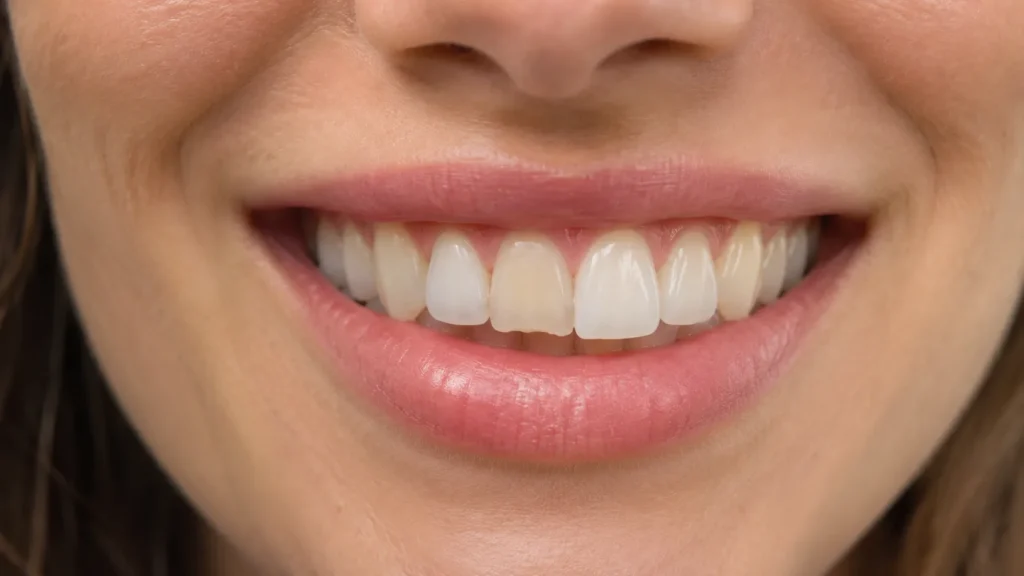
Yes. A dental veneer can sometimes be placed on a single tooth without treating the neighbouring teeth.
Whether it is appropriate depends on the tooth’s condition, the reason you want to change its appearance, your bite and the suitability of alternative treatments.
A veneer is not always necessary.
A small chip, for example, might be addressed with composite bonding. A minor colour difference may need a different investigation. An unhealthy or structurally compromised tooth may require treatment before any cosmetic procedure is considered.
The goal is not to treat the largest number of teeth. It’s to identify the smallest appropriate treatment that addresses your concern.
1. Why Is One Tooth Sometimes More Noticeable Than the Rest?
Our eyes naturally recognise patterns.
When you smile, the upper front teeth form a visual arrangement of shapes, edges, colours and spaces.
If one tooth differs from the others, that difference can catch your attention.
Think about a row of books on a shelf. One book sitting slightly forward may be more noticeable than the rest, even though nothing is fundamentally wrong with the arrangement.
A smile works in a similar way.
Common reasons one tooth might attract attention include:
- A chipped or worn biting edge
- A tooth that is slightly shorter
- A darker tooth following an injury
- An old, visible filling
- A minor difference in tooth shape
- A small gap next to one tooth
- Developmental differences in enamel
- A tooth that appears slightly rotated
Some of these differences are entirely normal and do not require treatment.
Others may be related to dental disease, trauma or wear.
Before changing the appearance of a tooth, it is important to understand why it looks different.
2. What Exactly Does a Single Dental Veneer Do?
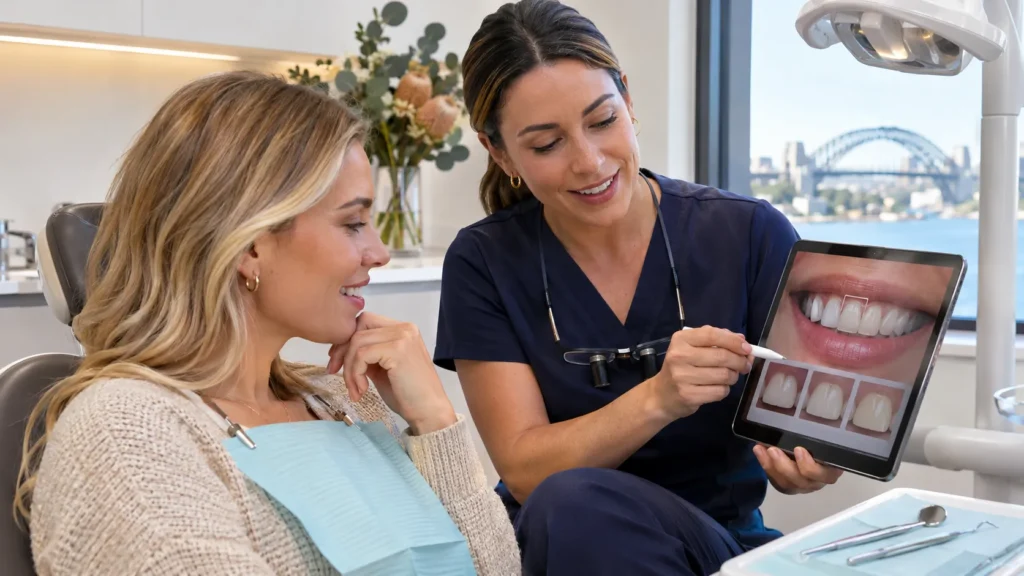
A veneer is a thin restoration attached to the front surface of a tooth.
It can be designed to alter the visible colour, shape, proportion or surface appearance of the tooth.
Veneers are commonly made using ceramic materials or tooth-coloured composite resin.
For one front tooth, the restoration is planned to blend with the surrounding natural teeth rather than create a completely new smile.
That distinction matters.
The dentist has to consider several visual details.
Tooth length
If one front tooth is shorter, a veneer may be considered to change its visible length.
However, the reason for the difference should be investigated first.
A shortened tooth may have worn down because of grinding or an unfavourable bite.
Adding material without addressing the cause could create a risk of further damage.
Tooth width
A narrow tooth can create the appearance of extra space.
In some cases, its shape may be modified using a restoration.
The dentist will consider whether changing one tooth would make the overall proportions more balanced or introduce another mismatch.
Tooth colour
One of the greatest challenges is matching a veneer to natural teeth.
Natural teeth aren’t a single flat shade. They can have variations in opacity, brightness and colour from the gumline to the biting edge.
A restoration that matches the colour but not the translucency can still look different.
Surface texture
Real teeth contain small ridges, contours and reflective surfaces.
Matching these characteristics can help a restoration blend with the rest of the smile.
Gumline appearance
The visible position of the gumline also contributes to symmetry.
A veneer cannot necessarily correct every gum-related difference, and additional procedures are not always appropriate.
3. When Might a Single Veneer Be Worth Considering?
There are situations where a veneer may be one treatment option.
Scenario 1: A front tooth has a visible chip
You’ve lived with a chipped corner for years.
It doesn’t cause pain, but you notice the irregular edge whenever you smile.
Depending on the amount of tooth structure remaining, composite bonding may be a relatively conservative option.
A veneer might be discussed when the appearance concern is more extensive or another restoration is clinically justified.
Scenario 2: One tooth has persistent discolouration
A front tooth has become noticeably darker than its neighbour.
Before discussing veneers, the dentist should investigate the cause.
Previous trauma, changes inside the tooth, or problems affecting the pulp can contribute to discolouration.
Some cases may need endodontic assessment or other dental care.
A veneer may be discussed only after the tooth has been appropriately evaluated.
Scenario 3: A small tooth looks different from the others
Sometimes one tooth naturally develops smaller or differently shaped.
Depending on its position and surrounding space, composite bonding or a veneer may be considered to change its appearance.
Not every small tooth needs treatment, and any intervention should be based on the patient’s preference and clinical needs.
Scenario 4: An old restoration is noticeable
A front-tooth filling may look darker than the surrounding enamel as the materials and natural teeth age differently.
Replacing or repairing the existing restoration may be an option.
A veneer should not automatically be the first recommendation simply because the concern is cosmetic.
For a broader overview, explore dental veneers at Westbrook Family Dental.
4. Single Veneer, Bonding or Whitening: How Do You Decide?
This is often the most useful part of a cosmetic consultation.
Different concerns call for different solutions.
| Your main concern | Possible option to discuss | Important consideration |
| Small chip | Composite bonding | May require less tooth preparation |
| One tooth has a different shape | Bonding or veneer | Suitability depends on anatomy and bite |
| Several natural teeth are stained | Teeth whitening | Existing restorations will not bleach |
| One tooth is darker after trauma | Dental assessment first | Cause of colour change must be investigated |
| Large or failing front-tooth filling | Repair, replacement or other restoration | Remaining tooth structure matters |
| Tooth appears rotated | Orthodontic assessment | Covering the appearance does not reposition it |
| Extensive damage | Restorative treatment | A veneer may not provide enough coverage |
The table is not a treatment recommendation. It simply illustrates why a diagnosis matters.
If the issue is primarily colour, teeth whitening Toowoomba may be discussed where the teeth are suitable for bleaching.
If the tooth has significant structural damage, whitening alone would not address that problem.
A good treatment plan starts with the condition of the tooth rather than the popularity of a procedure.
5. Why Is Matching One Veneer Sometimes Harder Than Matching Several?
This might sound surprising.
Surely treating one tooth is easier than treating eight?
Not always.
When several front teeth are restored, the dentist and dental technician may be able to create a more uniform design across those teeth.
With a single veneer, the restoration must match everything around it.
The neighbouring teeth remain unchanged. Their natural colour, texture, shape and light reflection establish the standard.
Even a small mismatch may become visible under certain lighting conditions.
Consider what happens when you move from natural daylight into warm indoor lighting.
The shade of a restoration may appear slightly different depending on how its materials reflect and transmit light.
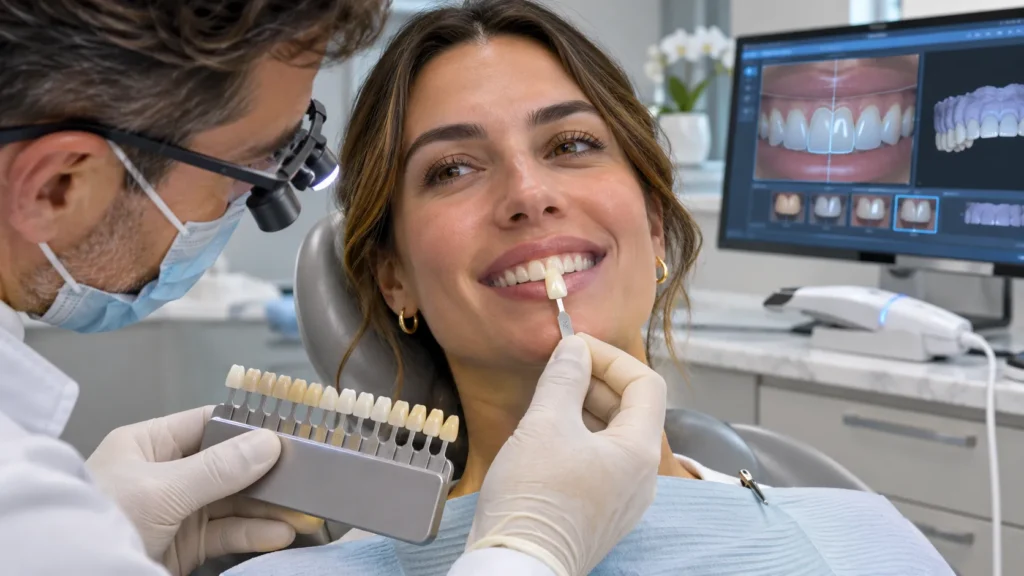
This is why colour selection isn’t simply about choosing a shade from a chart.
The dentist may assess photographs, tooth characteristics, the existing colour and the position of the affected tooth.
Your expectations also matter.
A restoration that blends naturally may look more appropriate than one that is noticeably brighter than its neighbours.
6. Should You Whiten Your Teeth Before Getting One Veneer?
Sometimes, but not always.
If you want your natural teeth to be lighter, it may be sensible to discuss whitening before a veneer is made.
Why?
Because veneers do not respond to bleaching in the same way natural teeth do.
Imagine having a veneer made to match your current tooth shade. Six months later, you decide to whiten your natural teeth.
The surrounding teeth may become lighter, while the veneer retains its original colour.
That could make the restored tooth more noticeable.
When whitening is clinically appropriate, the dentist may recommend completing it first and allowing the shade to stabilise before selecting the final restoration colour.
However, whitening may be unsuitable for some patients, particularly when sensitivity, oral health problems or other factors are present.
A cosmetic dentist Toowoomba can help you understand how the order of treatment may affect the overall appearance.
7. Does Getting a Veneer Mean Your Natural Tooth Will Be Shaved Down?

This is one of the most important questions to ask.
Some veneer treatments require removing a small amount of tooth structure to create space for the restoration and achieve an appropriate contour.
The extent of preparation varies.
It depends on factors including the tooth’s position, shape, colour, existing structure and the selected material.
Other cases may allow minimal preparation, although so-called no-preparation veneers are not suitable for everyone.
Even when a treatment is described as minimally invasive, you should ask exactly what will happen to your natural enamel.
Once enamel is removed, it does not regenerate.
That means a veneer can create an ongoing commitment to restoration maintenance or replacement.
Before agreeing, ask:
- How much natural tooth structure would be removed?
- Could composite bonding achieve a reasonable result?
- Is it possible to leave the tooth untreated?
- What could happen if the veneer chips or becomes loose?
- Could I need further treatment in the future?
A beautiful cosmetic result should never be presented without explaining the permanent implications of treatment.
8. What Happens During a Single-Veneer Consultation?
A consultation is an opportunity to explore your concerns rather than commit to a procedure immediately.
Your dentist may begin by asking what bothers you about the tooth.
Is it the colour? A chipped edge? An old filling? Something you only notice in photographs?
Next comes the clinical assessment.
The dentist may examine the tooth, gums and surrounding structures, review the bite and consider whether imaging or other investigations are necessary.
If a veneer is suitable, treatment planning may involve photographs, impressions or digital scans.
The precise process will depend on the selected material and clinical circumstances.
Planning the appearance
You may discuss tooth proportions, colour, edge shape and how the restoration will blend with neighbouring teeth.
It’s helpful to describe what you want in ordinary language.
For example:
“I don’t want this tooth to look perfect. I just want it to stop standing out.”
That is useful information.
It tells the dentist that your priority is subtle improvement rather than a dramatic change.
Understanding the costs
Ask for a written treatment plan where appropriate.
You should understand what is included, whether additional procedures may be necessary, and what future maintenance could involve.
Cosmetic treatment is a personal decision, and patients should have time to consider their options.
9. What Can Cause a Veneer to Chip or Fail?
Veneers are restorations, not permanent natural tooth replacements.
They can be damaged, loosen, wear or eventually need replacement.
Potential contributing factors include:
- Grinding or clenching teeth
- Biting hard objects
- Dental trauma
- Changes in bite forces
- Wear or deterioration of the bonding interface
- Existing dental problems
- Poor oral hygiene and decay around restoration margins
Material selection and appropriate planning can influence outcomes, but no veneer is guaranteed to last indefinitely.
Some patients may benefit from a protective appliance if they grind their teeth. This should be assessed individually.
If a veneer becomes loose or breaks, avoid trying to reattach it yourself.
Keep any detached fragment if practical and contact a dental clinic.
If the tooth is painful, sharp, traumatised or sensitive, seek prompt advice.
10. Can a Single Veneer Look Natural in Photographs?
Yes, a natural-looking result may be achievable, although outcomes depend on individual conditions.
The key is recognising that natural teeth have variation.
They’re not all perfectly rectangular or identical in colour.
A small difference in edge shape or translucency may be part of what makes a smile look authentic.
When discussing your preferences, consider the situations in which you usually notice the concern.
Do you see it in close-up selfies?
Does it stand out when you’re speaking?
Is the difference noticeable only under strong lighting?
These details can help explain your priorities.
It is also worth remembering that photographs can exaggerate certain features because of lighting, camera angle and image processing.
A cosmetic procedure should be based on a considered decision, not pressure created by an edited photograph or social media filter.
11. When Is Doing Nothing a Reasonable Option?
This deserves more attention in conversations about cosmetic treatment.
If a tooth is healthy and the appearance difference is minor, leaving it unchanged may be entirely reasonable.
You may decide that the long-term maintenance and potential risks of a veneer are not justified by the concern.
Alternatively, you might prefer to monitor the tooth and reconsider treatment later.
Cosmetic dentistry is about choices.
Those choices include conservative treatment, more involved treatment and no treatment.
Your dentist should help you understand the benefits and limitations of each option without making you feel that a normal variation in your smile is a defect.
12. A Single-Tooth Smile Checklist
Before deciding on a veneer, consider the following:
- Health: Has the tooth been checked for decay, cracks or previous trauma?
- Cause: Do you understand why it looks different?
- Alternatives: Have you discussed bonding, whitening, repair or no treatment?
- Preparation: Do you know whether enamel would be removed?
- Appearance: Have you explained what a natural-looking result means to you?
- Maintenance: Do you understand that the restoration may eventually need repair or replacement?
- Cost: Have you discussed the total treatment cost and potential future expenses?
- Timing: Are you making the decision without unnecessary pressure?
The more clearly you understand these questions, the easier it becomes to make a choice that suits you.
Frequently Asked Questions
Can I get one veneer instead of six or eight?
Yes, a single veneer may be appropriate for some patients. Whether it will achieve your desired appearance depends on tooth position, colour, shape and other clinical factors.
Can a veneer close a small gap?
In selected cases, a veneer or bonding may alter the appearance of a small gap. Larger spaces or alignment concerns may require other treatment.
Is a single veneer cheaper than a full smile makeover?
Treating fewer teeth may involve a lower overall cost, but the fee depends on material, complexity, investigations and other required treatment. Ask for an individual estimate.
Will a veneer feel different from my normal tooth?
A well-designed restoration should be planned with comfort and function in mind, but patients may notice some differences initially. Contact your dentist if it feels uncomfortable or interferes with your bite.
Can a veneer be removed later?
Removing a veneer is possible, but if the natural tooth was prepared, it may require another restoration. The original enamel cannot simply be restored to its previous state.
Should I get a veneer if I grind my teeth?
Grinding can increase the risk of restoration damage. Your dentist should assess your bite and habits before recommending treatment.
Sometimes the Smallest Change Is the Right One
You don’t necessarily need a completely different smile to address one feature that bothers you.
For some people, a modest repair or carefully planned restoration may be worth considering.
For others, no cosmetic treatment is the best choice.
The important thing is understanding your options and avoiding unnecessary changes to healthy tooth structure.
If one tooth has been on your mind for years, a consultation can help you find out whether a conservative solution is possible.
About Westbrook Family Dental
At Westbrook Family Dental, we provide personalised general and cosmetic dental care to patients in Westbrook, Toowoomba and neighbouring communities.
Whether your concern involves one chipped tooth, a visible filling, uneven tooth colour or a broader cosmetic goal, our dental team can assess your oral health and discuss available treatment options.
Our approach begins with understanding your concern and considering treatments appropriate to your individual needs.
Clinic Address: Shop 2/85 Main Street, Westbrook QLD 4350
Phone: (07) 4529 7477
Website: https://westbrookdental.com.au/
Arrange a cosmetic dental consultation to discuss your options before making changes to your natural smile.






Comments are off for this post.