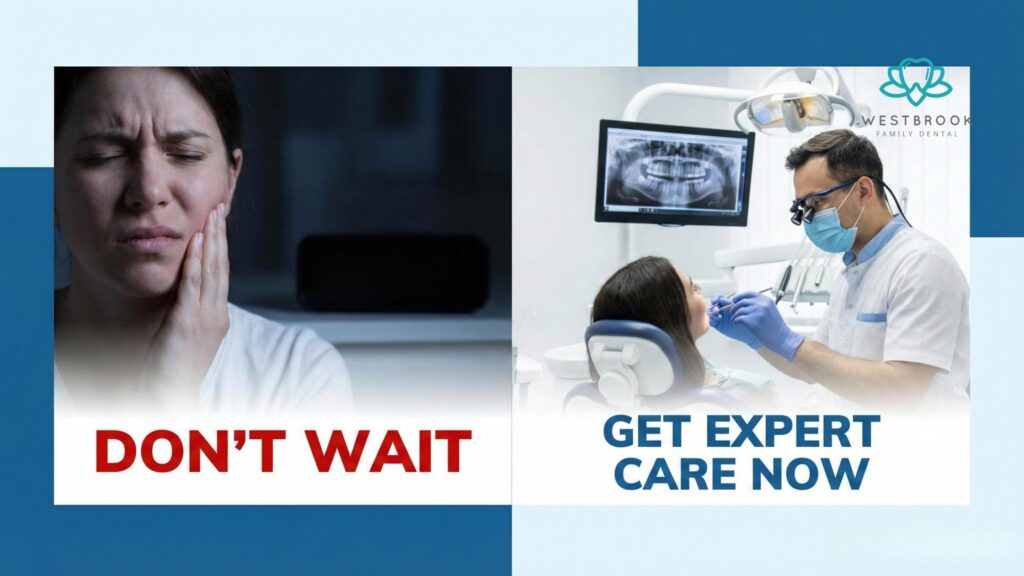

It starts as a dull throb while you’re drinking your morning coffee. You ignore it. By lunch, it’s a sharp zing when you bite down. You take a painkiller and hope it goes away. By bedtime, the pain is keeping you awake, pulsing in time with your heartbeat.
If this sounds familiar, you are not alone. A vast number of patients try to “tough out” dental pain, hoping the problem will resolve itself or that a quick search for home remedies will provide a cure. We often see patients days—sometimes weeks—after the initial symptoms started. By the time they type “Emergency dentist near me” into their phones, they are often in excruciating pain and facing more complex procedures than if they had come in immediately.
At Westbrook Family Dental, we want to change the narrative around urgent dental care. It isn’t just about fixing a problem; it’s about understanding that teeth cannot heal themselves. Unlike a scraped knee or a bruised shin, a tooth has no mechanism to repair a cavity, a crack, or an infected nerve on its own.
In this in-depth guide, we will explore why the “wait and see” approach is dangerous, why home remedies are often a trap, and why professional intervention is the only way to truly stop the pain.
The Anatomy of a Toothache: What Is Actually Happening?
To understand why you need an emergency dentist, you first need to understand the source of your pain. A toothache isn’t just “bad luck”; it is a biological alarm system.
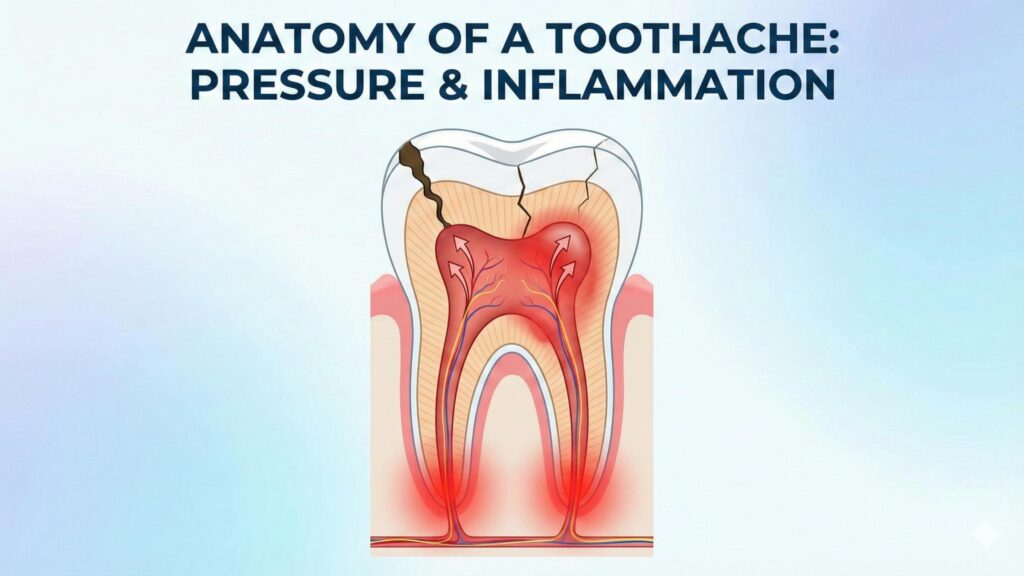
Your tooth is made of layers. The outer layer, enamel, is the hardest substance in the human body. Beneath that is dentin, a softer, porous layer. At the center is the pulp—a living network of blood vessels, connective tissue, and nerves.
When the Fortress is Breached
When decay or a crack penetrates the enamel and dentin, it exposes the pulp. Bacteria from your mouth invade this sterile environment. The body’s immune system reacts by sending white blood cells to fight the infection, causing inflammation.
In any other part of the body, inflammation causes swelling (think of a sprained ankle). But your tooth pulp is trapped inside a hard, rigid chamber. There is no room to swell. This builds immense internal pressure, strangling the blood supply and pressing directly on the nerve. This is the throbbing, relentless pain you feel.
The Reality Check: No amount of rinsing, brushing, or wishing will reverse this biological process. The pressure must be relieved mechanically by a dentist. Delaying this leads to nerve death (necrosis), which stops the pain temporarily—only for it to return with a vengeance as a dangerous abscess in the jawbone later.
The Myth of Home Remedies: Help or Hindrance?
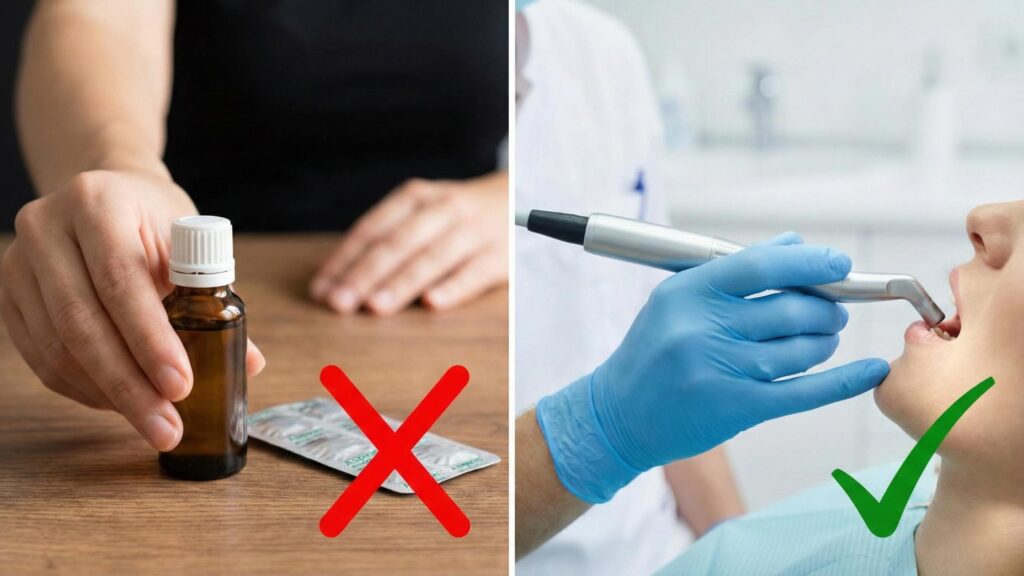
When pain strikes at 2:00 AM, it is natural to look for immediate relief. The internet is full of “hacks” for curing toothaches. While some offer temporary numbing, many can actually cause chemical burns or worsen the issue.
1. Clove Oil and Numbing Gels
Clove oil (eugenol) is a natural antiseptic and mild anesthetic. Applying it might dull the sensation for 20 minutes, but it does not kill the deep-seated bacteria inside the nerve canal. It masks the symptom while the infection continues to spread.
2. The “Aspirin on the Gum” Myth
This is an old wives’ tale that we still see causing damage today. Placing a crushed aspirin directly against the aching tooth or gum causes an “aspirin burn.” The acid in the pill destroys the delicate soft tissue of the gums, leaving a painful, white chemical ulcer that hurts more than the original toothache.
3. Alcohol Rinses
Swishing with whiskey or brandy is another common folklore remedy. While the alcohol might act as a mild antiseptic, it also dehydrates the mouth, and the sugar content in the alcohol can actually feed the bacteria causing the decay.
4. Superglue for Broken Teeth
We have seen patients try to reattach a crown or fix a chipped tooth with household superglue. Please, never do this. Superglue is toxic. Furthermore, it creates a seal that traps bacteria underneath the restoration, guaranteeing rapid decay that will likely require the tooth to be extracted later.
When you are in pain, skip the kitchen cabinet and look for the “Best dentist near me”. Professional diagnosis prevents you from turning a minor emergency into a major medical incident.
Specific Emergencies: The Consequences of Waiting
The “wait and see” approach has different risks depending on the type of emergency you are facing. Here is a breakdown of why time is of the essence for specific dental traumas.
The “Silent” Abscess
Sometimes, a toothache stops hurting on its own. You might think, “Great, I’m healed!” In reality, the nerve has likely died. The infection then exits the tip of the root and eats away at the jawbone, forming a pocket of pus called an abscess.
- The Risk: An untreated abscess can lead to a systemic infection. The bacteria can spread to the floor of the mouth, the throat (compromising breathing), or even the heart valves.
- The Treatment: Root canal therapy is needed to clean out the infection and seal the tooth.
The Lost Filling or Crown
If a restoration falls out, the sensitive understructure of the tooth is exposed.
- The Risk: Without the protective covering, the remaining tooth structure is weak and prone to shattering. Additionally, the exposed dentin allows bacteria to migrate rapidly toward the nerve.
- The Treatment: If caught early, we can simply replace the filling or re-cement the crown. If you wait, the tooth may decay to the point where it needs a root canal or extraction.
Gum Inflammation and Foreign Objects
Sometimes the pain isn’t the tooth, but something trapped below the gum line (like a popcorn hull or berry seed).
- The Risk: This creates a localized periodontal abscess. The gum swells, bleeds, and pulls away from the tooth, potentially causing bone loss.
- The Treatment: Professional irrigation and removal of the object usually bring instant relief.
Pediatric Emergencies: Why Kids Can’t Wait
The “wait and see” approach is particularly dangerous when applied to children. A child’s immune system and dental anatomy are different from an adult’s.
When parents search for a “Dentist near for kids” or a “Childs dentist near me”, it is often because a child has woken up crying.
The Thin Enamel Factor
Primary (baby) teeth have much thinner enamel than adult teeth. This means that once a cavity starts, it can race through to the nerve in a matter of weeks, not months. A small dark spot can turn into a raging infection very quickly.
The Impact on Adult Teeth
Many parents mistakenly believe, “It’s just a baby tooth, it will fall out anyway.” However, a severe infection in a baby tooth can damage the developing permanent tooth sitting right underneath it in the jawbone.
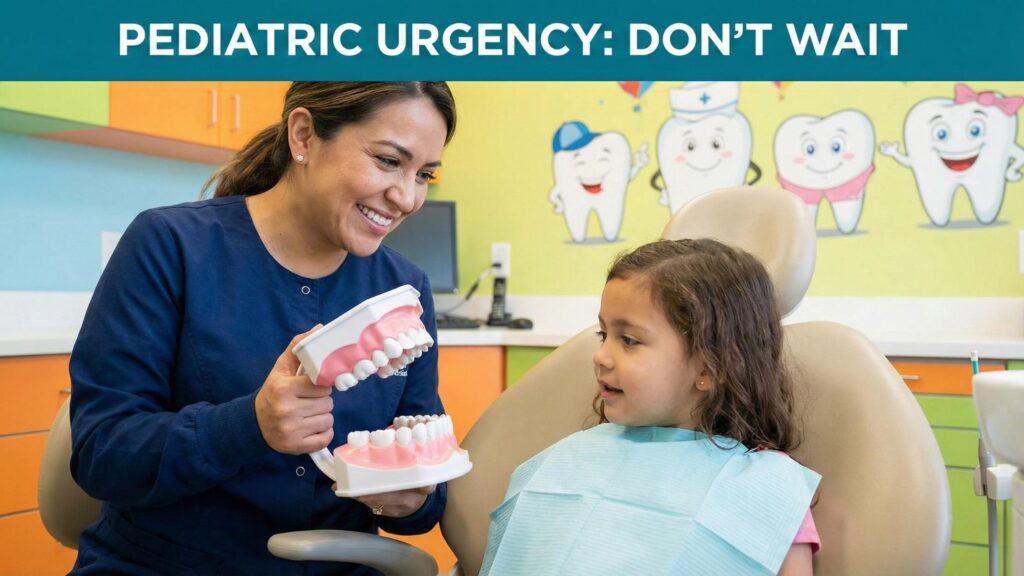
If you are looking for a “Children dentist near me” because of a fall, a bump, or a toothache, immediate action is vital to protect their long-term oral development. At Westbrook Family Dental, we prioritize pediatric emergencies to ensure your child has a positive, pain-free experience.
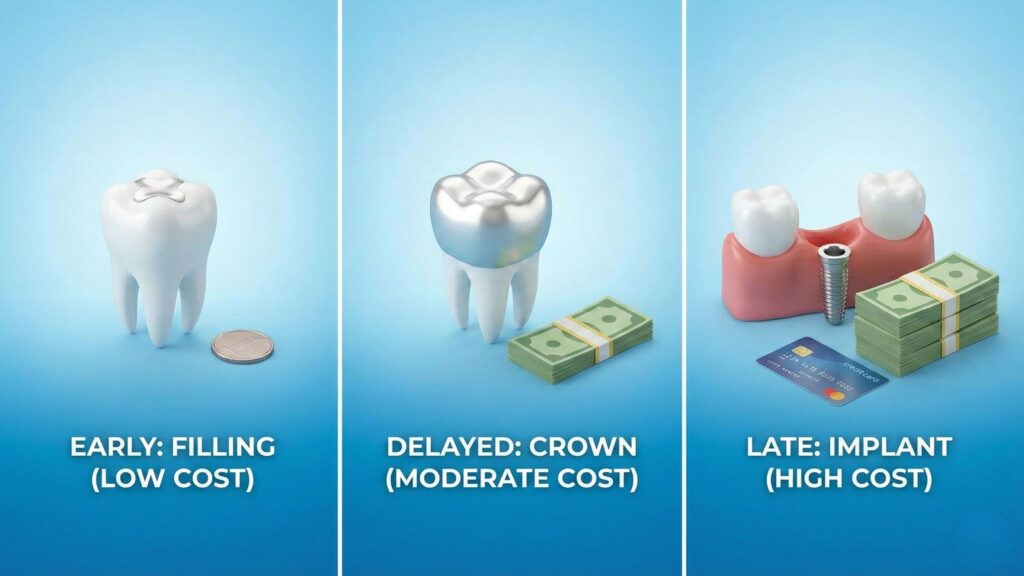
The Ultimate Cost: Saving the Tooth vs. Replacing It
There is a financial reality to dental emergencies. Many people delay treatment because they are worried about the cost. Ironically, delaying treatment almost always increases the cost.
The Window of Opportunity
- Day 1: A small ache. Treatment: A simple filling. (Low cost).
- Month 2: Constant throbbing. Treatment: Root canal and crown. (Moderate cost).
- Month 6: Severe swelling, tooth creates fracture. Treatment: Extraction and replacement. (High cost).
Once a tooth is lost, it must be replaced to prevent bone loss and shifting of adjacent teeth. At this stage, patients begin searching for “Dental implants near me”.
Dental implants are the gold standard for tooth replacement—they look, feel, and function like natural teeth. We are proud to offer high-quality implant solutions at Westbrook Family Dental. However, we are also honest: keeping your natural tooth is always the biological and financial preference. By seeing an emergency dentist immediately, you give us the chance to save your natural tooth, avoiding the need for surgical replacement later.
When the Emergency is Aesthetic: The Broken Front Tooth
Not all emergencies involve physical pain; some involve immediate social and psychological distress. Breaking a front tooth right before a job interview, a wedding, or a big presentation is a legitimate crisis.
In these moments, you need a provider who understands both structural repair and artistry. You need a “Cosmetic dentist near me”.
Modern dental bonding and veneers can perform miracles in a single visit. If you chip a front tooth:
- Find the fragment: If you can find the piece of tooth that broke off, keep it moist (in water or milk) and bring it with you. We can sometimes bond it back on.
- Don’t smooth it yourself: Do not use a nail file to smooth the jagged edge. You may remove vital enamel that we need for bonding.
- Call immediately: The faster we treat the tooth, the better the color match and retention of the repair will be.
How to Choose the Right Emergency Dentist
When you are in a crisis, you don’t have time to interview ten different clinics. However, knowing what to look for can ensure you get the best care.
- Accessibility: Does the clinic offer slots for urgent care? At Westbrook Family Dental, we keep time in our schedule specifically for unexpected pain.
- Technology: Does the clinic have digital X-rays for instant diagnosis? Do they have intraoral cameras so they can show you exactly what the problem is?
- Compassion: This is the most important factor. You are likely anxious and in pain. You need a team that listens, explains things clearly without jargon, and offers sedation or comfort options if you are fearful.
Conclusion: Listen to Your Body
Your body is smart. Pain is its way of telling you that something is wrong and requires attention. Ignoring that signal is like ignoring a fire alarm in your house—it won’t make the fire go away; it just lets it burn longer.
Don’t rely on unproven home remedies. Don’t wait until the pain is unbearable. And certainly, don’t wait until a simple filling turns into a complex extraction.
If you are experiencing:
- Persistent toothache
- Sensitivity to hot or cold that lingers
- Swelling in the gums or face
- A broken or knocked-out tooth
Take action now.
At Westbrook Family Dental, we are here to support you with professional, judgment-free emergency care. We have the technology to diagnose the issue instantly and the expertise to get you out of pain immediately.
Stop searching and start healing. Contact Westbrook Family Dental today. Let us turn your dental emergency into a distant memory.




Comments are off for this post.