When you lose a tooth, the immediate concern is usually visual. You look in the mirror and see a gap. You might feel self-conscious when you smile, or perhaps you struggle to chew a tough piece of steak.
Naturally, the first thought is to fill that gap. But what most patients don’t realize is that the gap in your smile is just the tip of the iceberg. Beneath the gum line, a silent, invisible process begins the moment a tooth is extracted. It is a biological chain reaction that, over time, changes the shape of your face, ages your appearance, and compromises your overall health.
If you are searching for “Dental implants near me”, you are likely looking for a way to restore your smile. But at Westbrook Family Dental, we want you to know that you are doing much more than that. You are preserving your youth and your jawbone’s structural integrity.
In this comprehensive guide, we will move beyond the cosmetic benefits and explore the biology of tooth loss. We will explain why bridges and dentures fall short, and why dental implants are the closest thing to a “time machine” for your oral health.
The Science of the “Sunken Face”: Understanding Bone Resorption
To understand why implants are necessary, we have to look at how your body works. Your body is incredibly efficient; it follows a rule known as the “use it or lose it” principle.
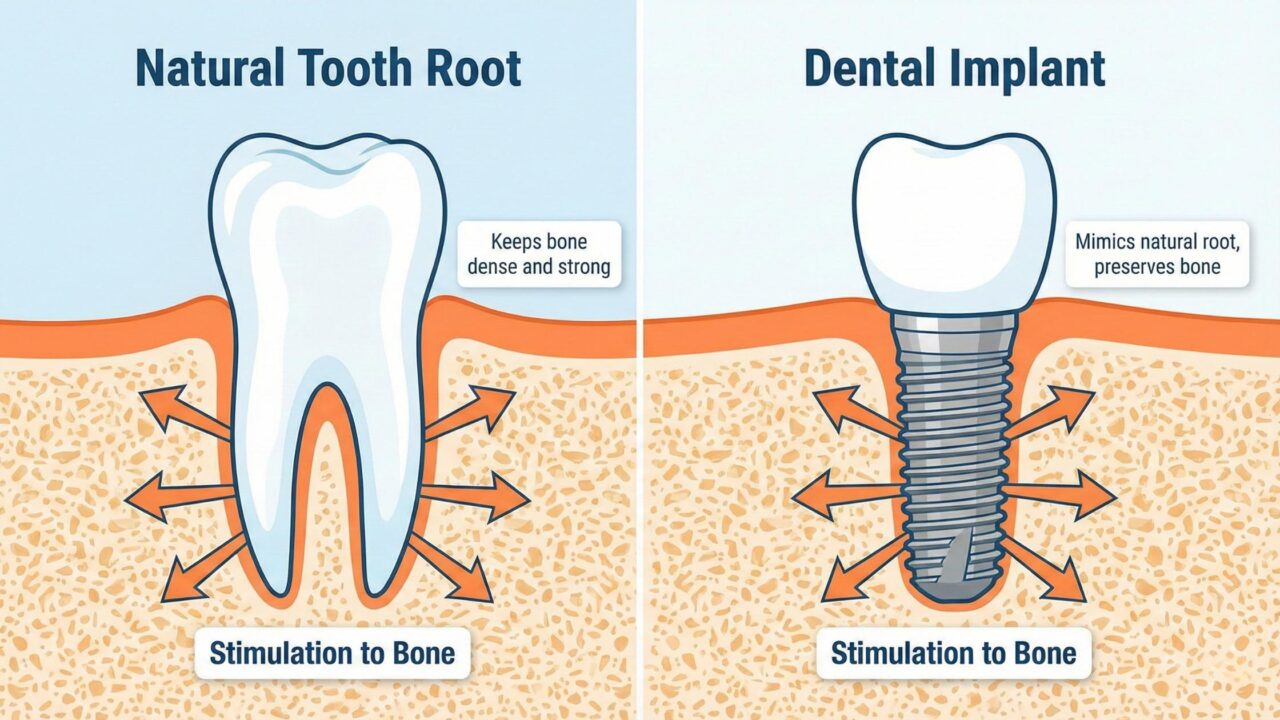
Your jawbone exists for one primary purpose: to hold your teeth. The roots of your natural teeth are embedded in the jawbone. Every time you chew, bite, or clench, those roots transmit physical force and stimulation deep into the bone tissue. This stimulation signals your body to send calcium and nutrients to the jaw, keeping the bone dense and strong.
What Happens When the Root is Gone?
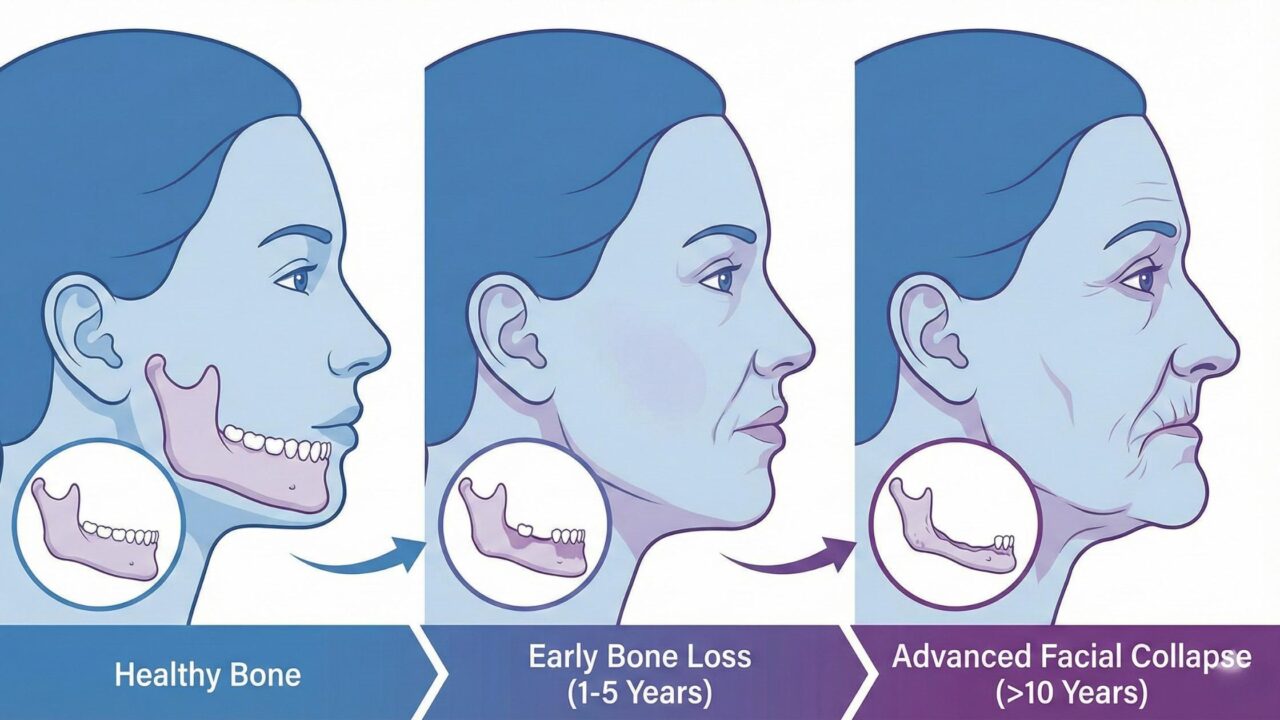
When a tooth is knocked out in a sports injury or extracted due to decay, that stimulation stops. The root is gone. Your body, realizing that the bone is no longer “needed” to support a tooth, begins to resorb it. It breaks down the bone tissue and recycles the minerals elsewhere in the body.
The Statistics are Alarming:
- In the first year after tooth loss, 25% of the bone width in that area is lost.
- Over the next few years, the bone continues to shrink in both height and width.
The “Granny” Look
This bone loss is what causes the “sunken” appearance often associated with elderly denture wearers. As the jawbone shrinks, the lower third of the face collapses. The lips curl inward, wrinkles form around the mouth, and the chin appears to protrude. This process can make a 45-year-old look 60.
This is why finding the “Best dentist near me” to discuss implants immediately after tooth loss is critical. Unlike any other replacement option, dental implants stop this aging process in its tracks.
Implants as Bio-Hacking: How They Trick the Body
Dental implants are unique in the world of medicine. While a denture sits on top of the gums and a bridge is anchored to neighboring teeth, an implant replaces the root of the tooth.
An implant is a small, medical-grade titanium post that is surgically placed into the jawbone. Titanium has a unique property called biocompatibility. The human body does not reject it; instead, it fuses with it.
This process is called Osseointegration.
Once the implant fuses with the bone, it functions exactly like a natural tooth root. When you chew on an implant crown, the force is transmitted down the titanium post and into the jawbone. This “tricks” the body into thinking the natural tooth is still there. The body resumes sending nutrients to the area, maintaining bone density and preserving your facial structure.
No other tooth replacement option—not dentures, not bridges—can do this.
The Digestive Connection: It’s Not Just About Chewing
We often separate our oral health from our general health, but digestion begins in the mouth.
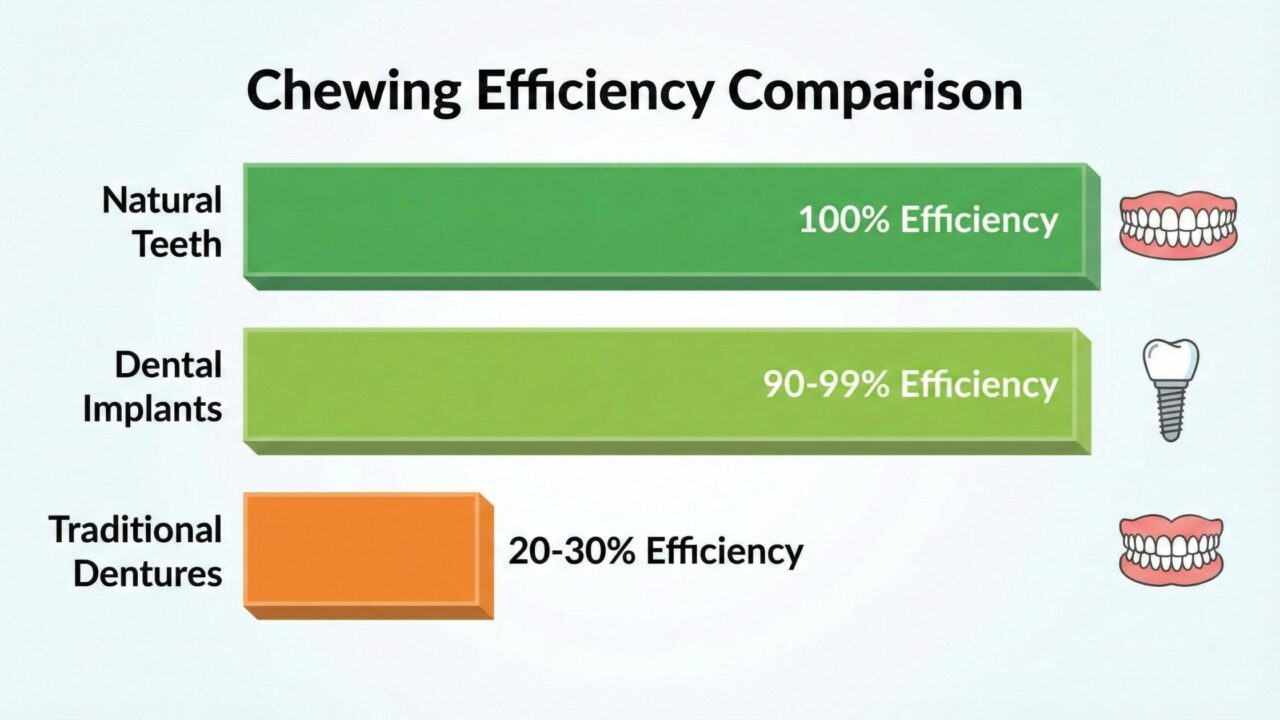
When you have missing teeth or ill-fitting dentures, your chewing efficiency drops dramatically.
- Natural Teeth: 100% chewing efficiency.
- Dental Implants: 90-99% chewing efficiency.
- Traditional Dentures: 20-30% chewing efficiency.
The “Soft Food” Trap
Patients with missing teeth often subconsciously alter their diet. They avoid fibrous vegetables, nuts, seeds, and tough proteins like steak. They gravitate toward processed, soft foods that are high in carbohydrates and easy to swallow.
This shift can lead to nutritional deficiencies and gastrointestinal issues. If you cannot chew your food properly, your stomach has to work overtime to break it down, leading to bloating and indigestion.
By choosing “Dental implants near me”, you are reclaiming your ability to eat a complete, nutrient-rich diet. You can bite into an apple, chew almonds, and enjoy a steak dinner without hesitation. You are investing in your long-term digestive health.
Why “Wait and See” is Expensive
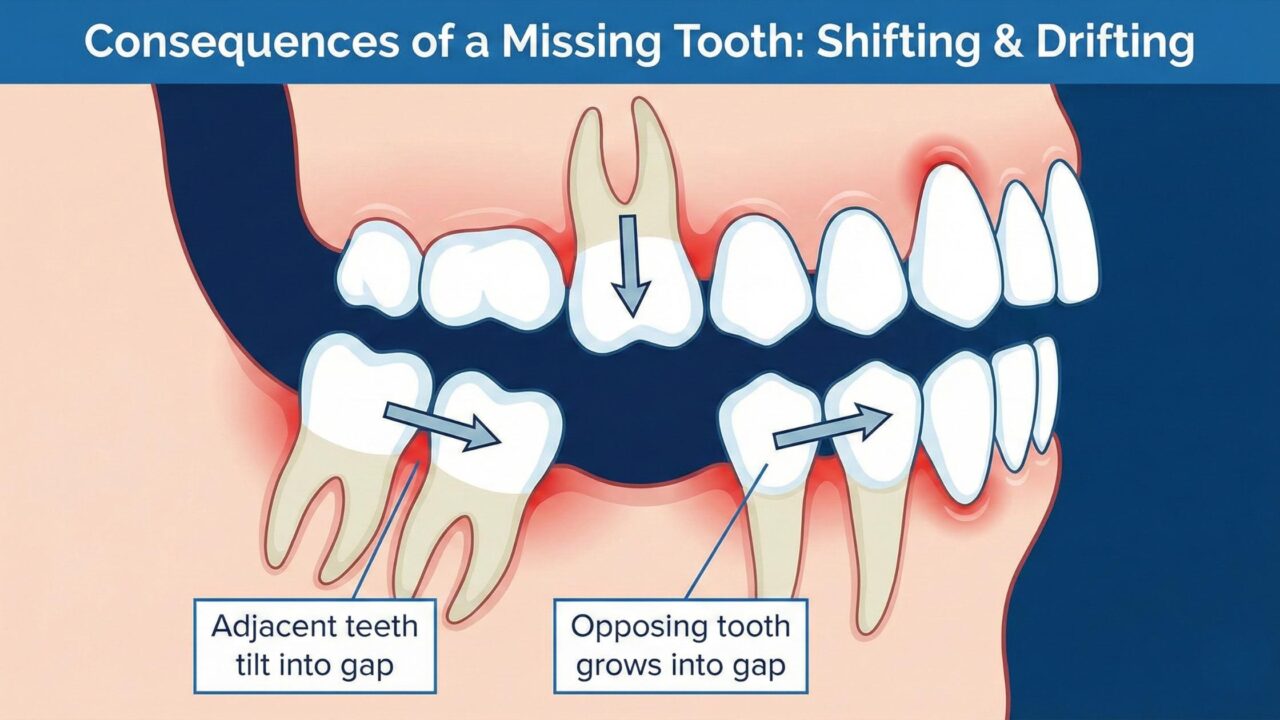
A common question we hear is: “Can I just leave the gap for a while and get an implant later?”
We understand that budget is a factor. However, waiting comes with significant biological and financial costs.
1. The Shifting Smile
Teeth are like books on a shelf. If you pull one out, the others lean over to fill the space. When you lose a tooth, the adjacent teeth will drift and tilt into the gap. The opposing tooth (the one above or below the gap) can also “supra-erupt,” growing out of the gum line as it searches for a partner to bite against. This misalignment can cause jaw pain (TMJ), headaches, and bite issues that require complex orthodontics to fix before an implant can even be placed.
2. The Vanishing Bone
As discussed, bone loss begins immediately. If you wait five years to get an implant, you may have lost too much bone to support one. This doesn’t mean you can’t get an implant, but it means you may require a bone graft first. This adds time, complexity, and cost to the procedure.
If you have recently lost a tooth due to an accident—perhaps requiring an “Emergency dentist near me”—the best time to discuss implants is right now.
Dental Implants vs. Bridges: The “Virgin Tooth” Debate
For decades, the dental bridge was the standard for replacing a single missing tooth. A bridge works by crowning the two teeth on either side of the gap and suspending a fake tooth between them.
While bridges are still a viable option, they have a major downside: collateral damage.
To place a bridge, the dentist must file down the healthy enamel of the neighboring teeth to fit the crowns. You are essentially turning two healthy teeth into “traumatized” teeth to support one missing tooth.
Dental implants are a “one-tooth solution to a one-tooth problem.” We do not need to touch, file, or damage your healthy adjacent teeth. They remain “virgin” teeth, untouched and intact. From a conservative dentistry standpoint, implants are almost always the superior choice for long-term health.
The Psychological Impact: Confidence Beyond Cosmetics

We cannot ignore the emotional weight of tooth loss. Whether it is a front tooth lost in a childhood sports injury (prompting a search for a “Childs dentist near me” for prevention advice) or a molar lost to decay, the gap affects confidence.
The “Denture Anxiety”
For those with multiple missing teeth, traditional dentures can be a source of constant low-level anxiety.
- Will they slip when I laugh?
- Will they click when I speak?
- Can I order this meal on a date?
Dental implants eliminate this anxiety entirely. Because they are anchored into the bone, they are rock solid. They do not slip, click, or move. You can sing, laugh, kiss, and eat with the total confidence that your teeth are part of you.
This psychological freedom is often what our patients value most. It’s the feeling of returning to “normal.”
Are You a Candidate? (It’s Not Just for Seniors)
There is a misconception that implants are only for the elderly. This is false. We place implants in young adults who lost a tooth to trauma, middle-aged professionals, and active seniors.
However, there is one major caveat for younger patients. If you are searching for a “Dentist near for kids” because your teenager lost a permanent tooth, we generally cannot place an implant until their jaw has finished growing (usually late teens or early 20s). In the meantime, we can provide a temporary spacer to hold the gap open and preserve the bone until they are ready for their permanent implant.
The Cosmetic Finish
Once the implant has healed, the final step is the crown—the visible tooth. This is where artistry meets engineering. If the implant is in the “smile zone,” you need a provider with an eye for aesthetics.
You might be thinking of a “Cosmetic dentist near me”, and you are right to do so. At Westbrook Family Dental, we custom-shade the porcelain crown to match your natural teeth perfectly. We layer the ceramic to mimic the translucency of natural enamel. The goal is for friends and family to look at your smile and have no idea which tooth is the implant.
The Process: Easier Than You Think
The phrase “oral surgery” sounds intimidating. However, implant placement is one of the most predictable and well-tolerated procedures in dentistry.
- Planning: We use 3D CBCT scans to map your nerves and bone density with sub-millimeter accuracy. We know exactly where the implant is going before we even begin.
- Placement: The procedure is performed under local anesthesia (just like a filling). Most patients report that the procedure was much faster and easier than the extraction of the tooth itself.
- Healing: You go home to heal for a few months while osseointegration occurs.
- Restoration: You return for the final crown and walk out with a complete smile.
Conclusion: An Investment in Your Future Self
When you look at the cost of dental implants, it is important to view it as a lifetime investment. A dental bridge may need to be replaced every 10 to 15 years. A denture may need relining every few years.
A well-cared-for dental implant has the potential to last the rest of your life.
It is an investment in a face that doesn’t collapse. It is an investment in a diet that keeps you healthy. It is an investment in the confidence to smile without holding back.
Don’t let bone loss dictate your future appearance. If you have a missing tooth, or if you are facing an extraction, let’s discuss your options.
Contact Westbrook Family Dental today. Let’s determine if dental implants are the right solution to restore your smile, your health, and your confidence.
Disclaimer: The information provided in this blog is for educational purposes only and does not substitute for professional medical advice. If you have a dental emergency, please contact a dental professional immediately.